 credits: Peter Huybers, NOAA National Climate Data Center
Sunday, August 14, 2011
Summer Insolation Forcing
For more information on Milankovitch Cycles and the role that changes in the Earth's orbital elements play in global warming see Huybers' 2006 paper on summer insolation forcing.
 credits: Peter Huybers, NOAA National Climate Data Center
credits: Peter Huybers, NOAA National Climate Data Center
Thursday, August 11, 2011
Approximate Formula For #Days From V Equinox to A Equinox, Take 2
I was able to compute an expression for the remaining constant in B(e) by expanding the integral for the difference in time as a linear function of the eccentricity near e = 0.
The constant is the derivative of the integral w.r.t. e at e = 0.

The formula gives a good approximation for the time it takes to go from the Vernal Equinox to the Autumnal Equinox if the orbital period, T0 (tropical year), the eccentricity, e, and the angle, θ, are known. There are higher order terms but the error is about 30 minutes or less.
The constant is the derivative of the integral w.r.t. e at e = 0.

The formula gives a good approximation for the time it takes to go from the Vernal Equinox to the Autumnal Equinox if the orbital period, T0 (tropical year), the eccentricity, e, and the angle, θ, are known. There are higher order terms but the error is about 30 minutes or less.
Tuesday, August 9, 2011
Variations in the Period of Annual Heating
Below is a plot of the curves for the formula for the number of days between the equinoxes in the previous blog with the eccentricity of the Earth's orbit, e, changing by steps of 0.01. The large red dot marks where the Earth is currently.

Note that the number of days between the equinoxes can vary by as much as 25 days. The image below is from the Wikipedia article on Milankovitch cycles.

The first curve (blue) shows the changes in the Inclination of the Ecliptic, ε. The second curve (green) indicates the much slower changes in the Earth's eccentricity, e. And, the third curve (purple) gives the changes in the angle of perihelion.
Local heating depends on the angular distance of the Sun from the local zenith and so is a function of the Sun's apparent inclination and the number of hours of daylight. At any given time the Earth may not be exactly in equilibrium with the current heating conditions. Looking at the "number of days of heating" and the changes that are taking place might give a better picture of what is happening than one might get from the integrals in the Wikipedia article on insolation.
Supplemental (Aug 10): The calculation didn't take into consideration changes in the semi-major axis, a, which would affect the mean motion and the length of the year. In perturbation theory the semi-major axis is considered an adiabatic invariant. This would justify the first coefficient in the formula being a constant rather than a function of the eccentricity, e.

Note that the number of days between the equinoxes can vary by as much as 25 days. The image below is from the Wikipedia article on Milankovitch cycles.
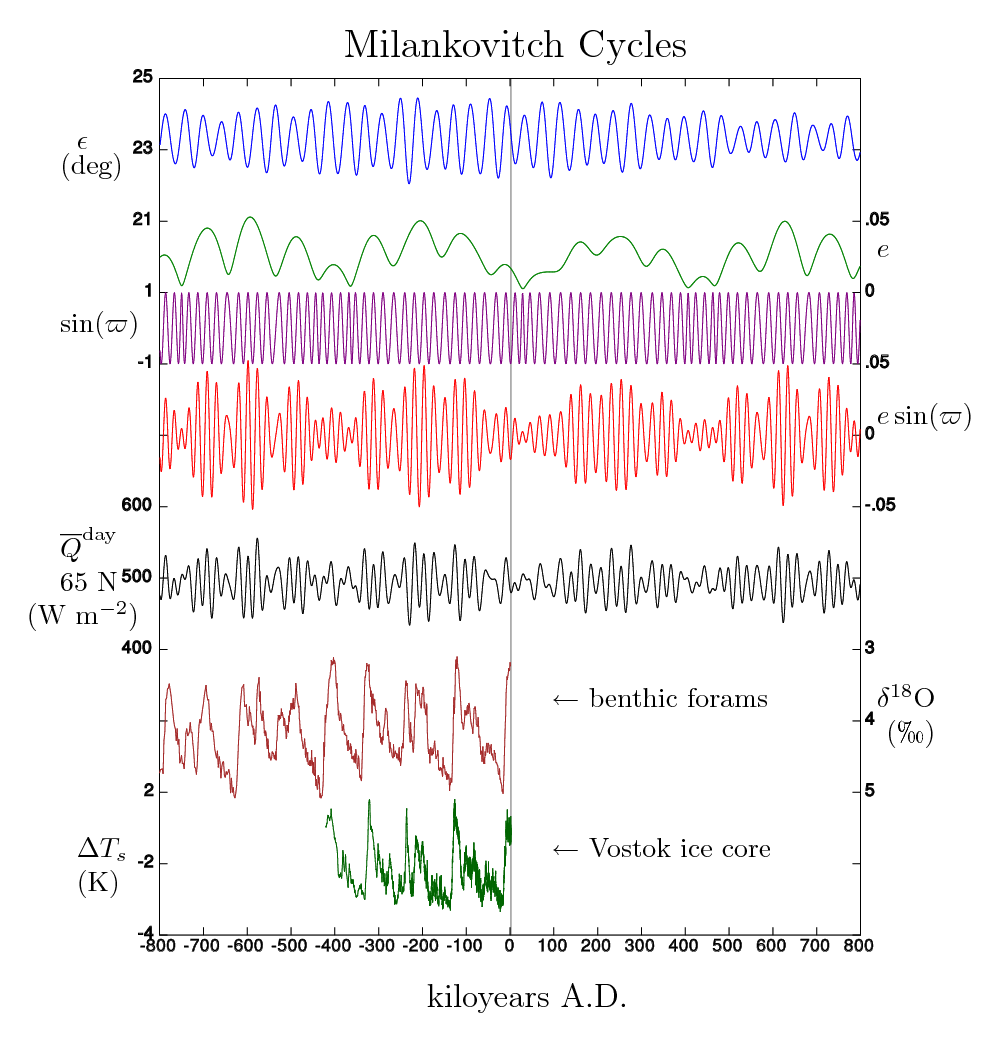
The first curve (blue) shows the changes in the Inclination of the Ecliptic, ε. The second curve (green) indicates the much slower changes in the Earth's eccentricity, e. And, the third curve (purple) gives the changes in the angle of perihelion.
Local heating depends on the angular distance of the Sun from the local zenith and so is a function of the Sun's apparent inclination and the number of hours of daylight. At any given time the Earth may not be exactly in equilibrium with the current heating conditions. Looking at the "number of days of heating" and the changes that are taking place might give a better picture of what is happening than one might get from the integrals in the Wikipedia article on insolation.
Supplemental (Aug 10): The calculation didn't take into consideration changes in the semi-major axis, a, which would affect the mean motion and the length of the year. In perturbation theory the semi-major axis is considered an adiabatic invariant. This would justify the first coefficient in the formula being a constant rather than a function of the eccentricity, e.
Empirical Formula for #Days Between V. Equinox & A. Equinox
I used different values for the eccentricity of the Earth's orbit, e, to get a set of values for the coefficients of the formula found last time. A turned out to be a constant equal to half the number of days in the year and B was a simple function of e. θ is the angle of Earth's perihelion from the direction of the Winter Solstice in the Earth's orbital plane or 90° behind the Vernal Equinox.

I labeled the function for the number of days from the Vernal Equinox to the Autumnal Equinox VEq2AEq. The empirical error bound is a simple cubic function within the range of e for the formula, 0 < e < 0.07.
Supplemental (Aug 10): The polynomial fit for B(e) had some near zero values so I tried doing a least squares fit for just odd powers of e and got a better fit.
The rms error was 2·10-10. The function appears to be,
B(e) = 232.520·(e - e3/3! - 3e5/5! + ···).

I labeled the function for the number of days from the Vernal Equinox to the Autumnal Equinox VEq2AEq. The empirical error bound is a simple cubic function within the range of e for the formula, 0 < e < 0.07.
Supplemental (Aug 10): The polynomial fit for B(e) had some near zero values so I tried doing a least squares fit for just odd powers of e and got a better fit.
The rms error was 2·10-10. The function appears to be,
B(e) = 232.520·(e - e3/3! - 3e5/5! + ···).
First Order Approximation For #Days of Summer
To first order the number of days in Summer function for apsidal precession is a constant plus a cosine function. ΔΔt, the error for the approximation, has a magnitude less than 0.0003 days.

As before θ is the angle between the Earth's perihelion and the Winter Solstice. Apsidal precession has to be considered as a contribution to global warming. If there is net annual heating due to apsidal precession then this contribution needs to be deducted before the effect of greenhouse gases can be determined. Only the change in the angle of angle of perihelion was taken into consideration and the other orbital elements were assumed to remain constant.

As before θ is the angle between the Earth's perihelion and the Winter Solstice. Apsidal precession has to be considered as a contribution to global warming. If there is net annual heating due to apsidal precession then this contribution needs to be deducted before the effect of greenhouse gases can be determined. Only the change in the angle of angle of perihelion was taken into consideration and the other orbital elements were assumed to remain constant.
Monday, August 8, 2011
Conclusion: 30° Months Probably Not Practical
Defining a month as the time that it takes for the Earth to move 30° in its orbit is likely not practical since it would require frequent changes to keep the months accurate. The dates of apsides, equinoxes and solstices are something better to relocate to an almanac. The same for the number of days of net heating which I have referred to as "summer". It's probably best not to overcomplicate the calendar. One can just as easily draw attention to the perihelion by making it an "Earth day" holiday.
So, what to do about the months? The 7/12ths trick might be useful. Simplifying the day-of-year function would make it easier to compute the number of days between two dates such as the time between one equinox and the next.
When making changes that affect a lot of people it's probably best to adopt a minimalist approach.
The Equinoxes divide the year into two parts. When the Sun is above the Equator there is relatively more warming during this "half" of the year than when it is below it. There doesn't seem to be any collective terms for Spring/Summer and Fall/Winter. But the Earth's heat balance is positive for the former since the temperature rises and negative for the later since it decreases as a study of the Earth's insolation and climate models show. What is often overlooked or downplayed is that there are indeed long term changes over time.
So, what to do about the months? The 7/12ths trick might be useful. Simplifying the day-of-year function would make it easier to compute the number of days between two dates such as the time between one equinox and the next.
When making changes that affect a lot of people it's probably best to adopt a minimalist approach.
The Equinoxes divide the year into two parts. When the Sun is above the Equator there is relatively more warming during this "half" of the year than when it is below it. There doesn't seem to be any collective terms for Spring/Summer and Fall/Winter. But the Earth's heat balance is positive for the former since the temperature rises and negative for the later since it decreases as a study of the Earth's insolation and climate models show. What is often overlooked or downplayed is that there are indeed long term changes over time.
Adjusting the Months to Fit the Earth's Orbidal Motion
If we wanted the Tropical Calendar to be a "Global Warming Calendar" we might adjust the number of days in each month to better fit the orbital motion of the Earth. We could make the length of each month correspond to a change of 30° relative to the Vernal Equinox. We would want the year to start in mid winter so the year would have to begin at the Winter Solstice or perhaps the next day.

Each of the months above fit this pattern with a Solstice or Equinox separating a block of three months. We could add the leap day at the end of the year where it was at one time or perhaps add it just before the Vernal Equinox to mark its significance as the date which we use to synchronize the calendar with the tropical year.
As the date of perihelion moves about in the year during the apsidal precession cycle periodic "calendar reforms" would be necessary to correct the lengths of the months to maintain the pattern of 30° monthly steps. It might be practical to do this every 1/12th of the 20,934 tropical year apsidal cycle which is about 1744 tropical years*. Leaving the calendar design somewhat open ended would allow changes to be made as our understanding of these changes increases and keep the calendar from becoming something rigidly preordained.
Supplemental: Basing the lengths of the months on the Earth's orbital motion was intended to focus attention of the Earth's heat balance and changes over time. There is a seasonal lag so temperatures do not exactly match the "seasons" but the highs and lows are delayed somewhat.
*Supplemental: Perihelion moves about 8.8° in 512 tropical years and 2.2° in 128 years. 512 years might be a little long to keep the system accurate and there is the problem of keeping people's interest in updating the calendar over that long a span of time. 128 years is more convenient because it could be done when the leap year is skipped but rearranging the calendar that often is a problem for historians.

Each of the months above fit this pattern with a Solstice or Equinox separating a block of three months. We could add the leap day at the end of the year where it was at one time or perhaps add it just before the Vernal Equinox to mark its significance as the date which we use to synchronize the calendar with the tropical year.
As the date of perihelion moves about in the year during the apsidal precession cycle periodic "calendar reforms" would be necessary to correct the lengths of the months to maintain the pattern of 30° monthly steps. It might be practical to do this every 1/12th of the 20,934 tropical year apsidal cycle which is about 1744 tropical years*. Leaving the calendar design somewhat open ended would allow changes to be made as our understanding of these changes increases and keep the calendar from becoming something rigidly preordained.
Supplemental: Basing the lengths of the months on the Earth's orbital motion was intended to focus attention of the Earth's heat balance and changes over time. There is a seasonal lag so temperatures do not exactly match the "seasons" but the highs and lows are delayed somewhat.
*Supplemental: Perihelion moves about 8.8° in 512 tropical years and 2.2° in 128 years. 512 years might be a little long to keep the system accurate and there is the problem of keeping people's interest in updating the calendar over that long a span of time. 128 years is more convenient because it could be done when the leap year is skipped but rearranging the calendar that often is a problem for historians.
Subscribe to:
Posts (Atom)