Thursday, October 4, 2012

Avoiding Misnomers

 
  The driftlike objects that I have named "zastrugi" illustrate the problem that we can have in naming something new to our experience. They may look like something we have seen before but occur elsewhere. The problem is one of identity. Are the objects the same? For biologists the problem is quite complicated and their nomenclature system is the solution that they have come up with. The objects most closely related are included in the same species. They are the same kind of objects. Other objects with roughly similar properties are grouped together as a genus. More distantly related objects form families and orders. To properly name something we need a classification system and a set of rules for making the identifications. Sometimes a genus takes the name of one of its members as in the case of vulpes vulpes, the red fox or lynx lynx, the European lynx. I use the name "zastruga" for the objects found on Mars in this broader sense since the Russians say it can refer to sand and gravel spurs in addition to shaped snow drifts. So if we wish we can use the name for a group of objects that is zastruga-like. Often we use the indefinite article to indicate membership is a class. For example we could say, "Felix is a cat," and, "Wolf is a dog."
 
  In this context what can be said about the "alluvial fan"? The word "fan" indicates a diverging deposit of some sort. The adjective "alluvial" indicates the active agent was water. If wind was the active agent we might say that it is an "aeolian fan". In the case of "talus cone" there is no active agent except gravity. In each case there is a slope that the particles of the deposit distribute themselves over in a manner similar to the way balls move down Galton's board. I used "cascade" as the general term for the field that particles travel over.
 
  As we explore Mars and the other planets it is likely we will encounter things outside our normal experience the scientists need to come up with a general procedure or set of guidelines or precedents to follow in coming up with new names and in identifying what is what. A classification system may prove to be the best approach to the problem.
 

Wednesday, October 3, 2012

A Fragile Zastruga


 The "zastrugi" don't seem to be able to take much weight as this Sol 56 anaglyph shows but the sides of the depression left by one of Curiosity's wheels didn't collapse as one would expect loose dry sand to do.
 

Tuesday, October 2, 2012

Zastrugi

 
  Some of the drifts in these Sol 55 anaglyphs look a like zastrugi. I use red and cyan for these anaglyphs and set green to their average to add more gray because of the problem with ghost images of the large drift. It helped a little both eyes still see some of complementary color.


Sunday, September 30, 2012

More Evidence Of Flaked Stones On Mars

 
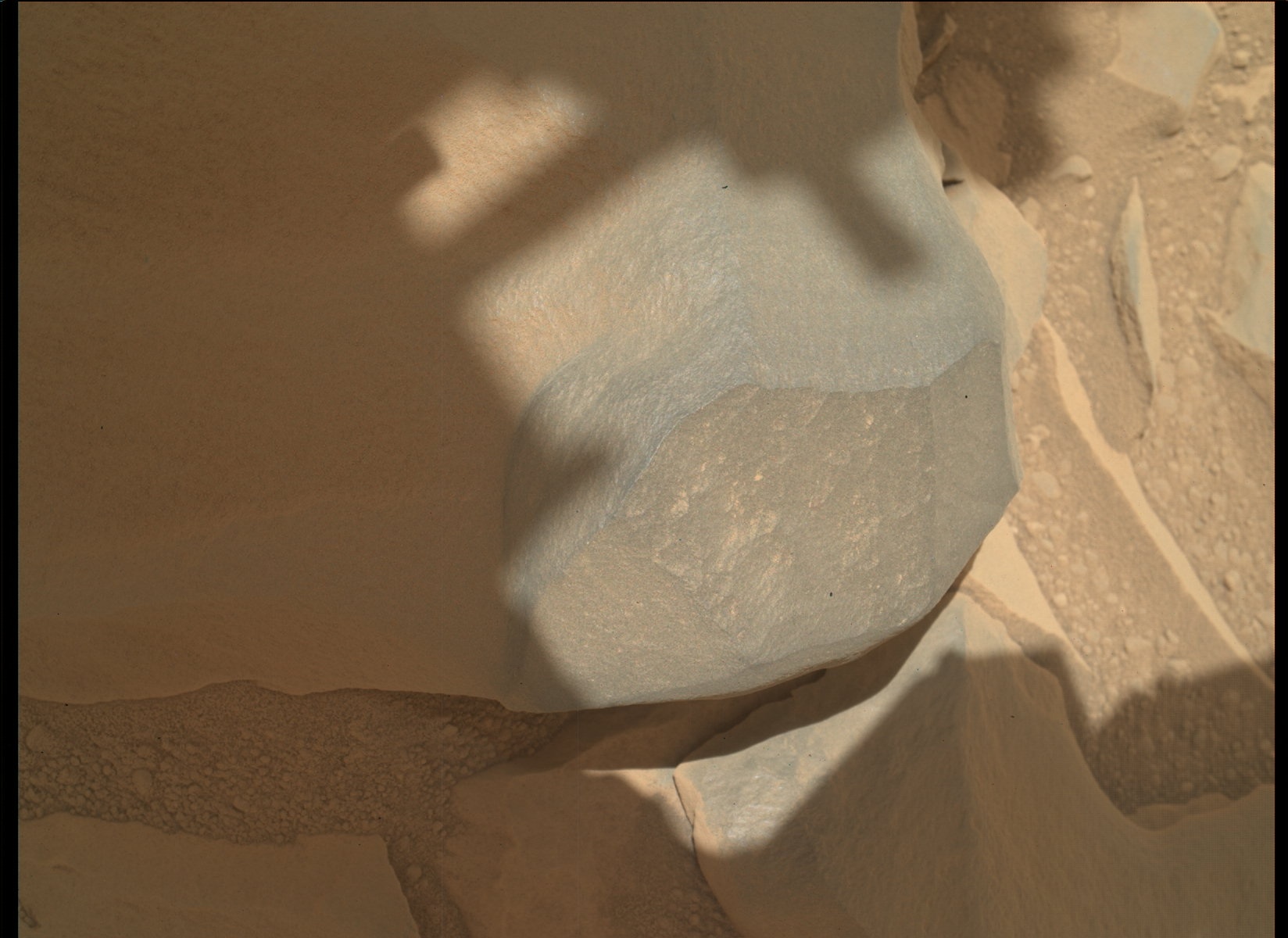
  Some Sol 54 MAHLI images show more evidence of stone flaking on Mars. This may be because basalt flakes easily. Stones were flaked to make tools by our human ancestors and some of their predecessors. People should be advised not to draw the wrong conclusion from this evidence.


Saturday, September 29, 2012

Posturing On The Alluvial Fan

 
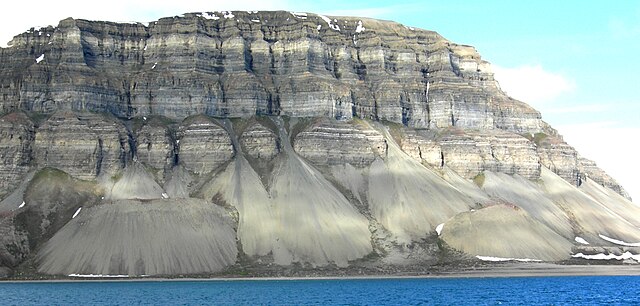
  An alluvial fan by definition is formed by the action of water. But in adopting an Earth-based or restricted point of view we can introduce a perceptual illusion like that of a mirage when we see water when it is not actually present. One finds geological features on Earth which are similar in appearance to the alluvial fan such as debris flows and other forms of mass wasting. An interesting case is that of the talus cones seen found in Svalbard.
 
src: Wikipedia
 
  Note in the image above that for each talus there is a funneling cone at the top, a channel and a debris field below. One can identify similar features at Gale Crater on Mars. Mountains to the north of the crater rim can act as a funneling cone. There is also a channel through the crater wall and a debris field but the slopes differ. The structure is somewhat like that of the Galton board which was introduced to illustrate the normal distribution. It too has a funnel, a channel and a cascade through which objects fall. The fan and the talus cone are flow fields for the material that is deposited below the channel. In the case of the alluvial fan one could generalize and to include some other flow field besides that of water to move material about. Mt Sharp appears to be more consolidated than the material around it since it appears to have withstood erosion better but we will have to wait and see what the actual data turns up before we can speak with any authority. Referring to an alluvial fan is just a first impression.
 

Friday, September 28, 2012

Sol 52 Anaglyphs - Rougher Terrain Ahead

 
  Emily Lakdawalla did a blog today with a map showing Curiosity's progress to Glenelg up to Sol 52. Today's anaglyphs show that the terrain will be getting more difficult from now on.


What Was The Gale Crater Stream Source?


  It's been claimed that there was once water flowing down the alluvial fan in Gale Crater and one might ask what was its source? The image above shows an Google Mars elevation profile for a path through the channel at the crater rim and down the alluvial fan. The area just to the north of the crater wall seems to have been filled in with material. Going farther north uphill one comes to what appears to be an eroded crater. Could this be a volcanic crater that has collapsed? Water is not necessary to explain the filled in material. It could have been blown in over a very long period of time. But could this collapsed crater or Mt Sharp have been a mud volcano? An underground source of churning mud might produce rounded stones like those from a rock tumbler and require less water to do so. A subsequent eruption could have deposited the material on the alluvial fan. We need to keep and open mind when it comes to an alien planet and perhaps the rock tumbler would be a good test that the proponents of flowing water on Mars would have to pass to prove their case. Appearances can be deceiving at times.