Saturday, April 21, 2012

Sun's Binocular Projection Corrected With "Granny Glasses"

One can use "granny glasses" to corrected the projected image of the Sun created with binoculars. I attached +1.25 D reading glasses to one side of the binoculars and focused the image onto a sheet of white paper at the ground level.
 
 
The image is comparable with that of the +1.0 D lens combination.
 
 
One can just make out the sunspots.
 

Friday, April 20, 2012

Contrast Enhancement

Contrast enhancement is a useful tool so I thought I'd do a simple illustration of the procedure involved. Below is a Mathcad function, contrast(img,lbnd,ubnd), that I wrote for this purpose. One just needs to specify which image to enhance and give the upper and lower bounds of the pixel values. The function then stretches these bounds to fit within the 0 - 255 range of values allowed for an image.
In this example the green portion of an image of the Sun was selected for enhancement. An image histogram can be used to select the upper and lower bounds. In the histogram below the right peak was produced by pixels from the Sun's disk and the left from the surrounding area so it is easy to select the bounding values.
The function then generated the contrast enhanced image and an image reduced in size was used to check the results for the selected bounds.

Thursday, April 19, 2012

Contrast Enhanced Sunspots

The comparison of the projected binocular image of the Sun with the GONG images wasn't quite fair since the GONG images are processed. Here is a contrast enhanced version of the binocular image.


The above image wasn't corrected for limb darkening.

Sunspots Just Visible In This Image

Atmospheric conditions cleared up some this afternoon and I was able to capture the following image of the Sun. The sunspots can just be made out.


Below is an image of the Sun taken by GONG a little earlier. My image appears to be inverted.


The sunspots in the projected image appear to be a little clearer if the image is moving across the paper. This may be due to the graininess of the paper being less noticable in a moving image. I should also note that the objectives of the binoculars are 50mm lenses.

A Better View of the Sun

I was able to lengthen the focal distance by adjusting the focus rocker bar on the binoculars and got a much larger image.


I was just barely able to make out sunspots. Conditions still weren't optimal.
The skies were clearer today but still slightly milky blue. I was able to determine the focal length with the +1D lens combination more precisely.


Placing the binoculars and screen on tripods allows for hands free observation. The binoculars were attached with rubber bands. Using a lower power lens system might enlarge the image a little more. With a 0.5D combination one might be able to double the image size.

There are simple and inexpensive ways of viewing an eclipse. Not everyone has a 10 inch telescope dedicated to solar observations for their use. For an outing easy setup is an advantage. Also in northern California one should consider bringing an umbrella and be prepared for a breeze on the beaches.

Wednesday, April 18, 2012

A Problem With Projecting The Sun's Image With Binoculars And Its Solution

I tried doing eyepiece projection with a pair of binoculars and found that they didn't focus the Sun's image of the very well. A small positive lens will converge the rays to form a better image. For a projective image the best focus for the binoculars by themselves occurs when the eyepiece is at its farthest extension. Again an aperture stop in front of the objective lens is needed to reduce the brightness of the image for ease of viewing.

I tried both a 2D (diopter) lens and a 1D = 3D + -2D combination from an Edmund Scientifics 38mm Demonstration Lens Set. With the 1D combination one can create an image 1 inch in diameter. The lens holder was a small "envelope" made from 20lb matte ink jet paper that was attached to the binoculars with cellophane tape.
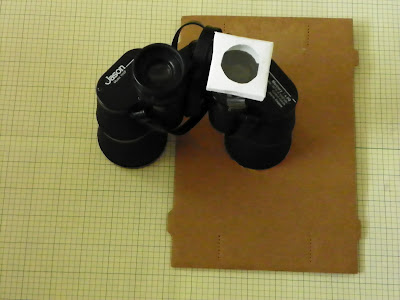

It helps to leave one of the lens caps on the binoculars and add a cardboard shade. An index card can be used as an imaging screen. The farther away the index card is the larger the image one gets. The aperture may need to be increased for larger images. I found it difficult to find the focal point. There were still some thin clouds out today.
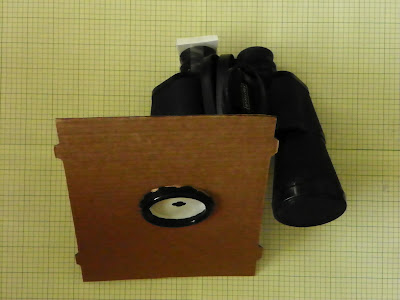

The binoculars are a pair of Galilean telescopes and so the eyepieces are diverging. They were designed to work close to the eye and adding a positive lens corrects the focusing problem. I tried taping the 1.50D clip-on reading glasses over both eyepieces and found that will work if one does not have a lens set available.